
<- Back
Follow the Child By Ananya Pattanaik
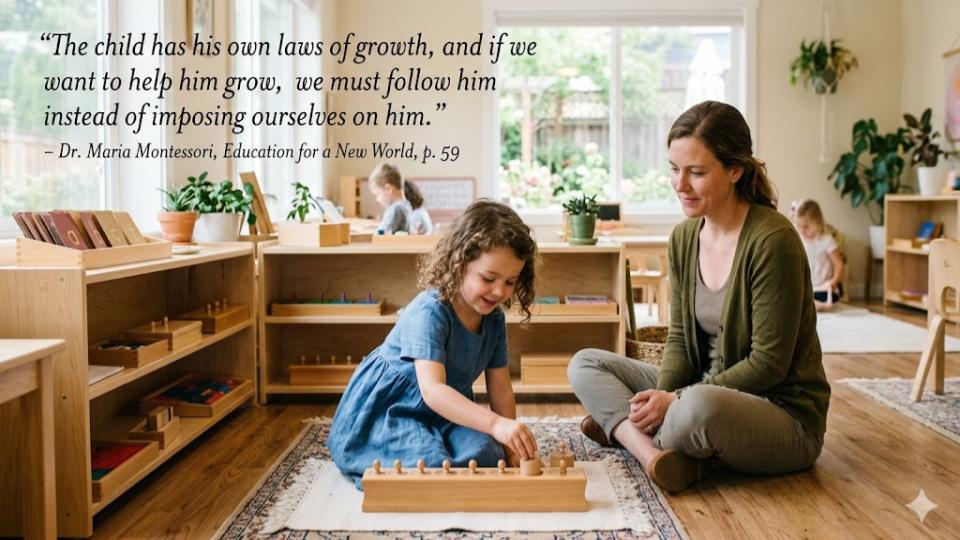
- What did Dr.Montessori mean when she said “follow the child” ?
- What do you mean by “follow the child”? Are we following them over the edge of a cliff?
- “Follow the child” is a phrase so many Montessori professionals use when describing how we go about working with and assessing the skills of a student.
- Montessorians are often heard saying, “Follow the child.” It’s a statement that guides us each day and drives our work in very particular ways. We believe the child has innate qualities that lead them to learning, and it is our job to prepare the path and then get out of the way.
- When Montessori educators say we follow the child with no explanation-it diminishes what the practice looks like.
- How can we not use the term loosely ?
We follow the child when we take time to get to know them(connect).
We follow the child when each day, each week, each month, we sit and observe the child and see what
their Human tendencies are (and are not). One of the great discoveries made by Dr. Montessori was that
all humans have certain tendencies or behavior patterns. No matter where we live, no matter our culture
or ethnicity, we all follow the same natural laws that lead us to act or react in a specific manner. We
are all driven to
- Communicate
- Socialize
- Imitate
- Explore (we are curious)
- Move
- Be exact/precise
- Concentrate
- Repeat
- Maintain/discover order
- Achieve independence
- Realize perfection/Control errors/Improve ourselves
- Control ourselves (physically, intellectually, emotionally)
- Work
➜ We follow the child when we take the information our observations supply us with and use it to inform our practice.
➜ We follow the child when we meet them where they are and support them through the following steps in their social, emotional and academic learning.
➜ We follow the child when we watch them, listen to them and guide them in the right direction.
➜ We follow the child not to let them make all of their own choices, solve all of their own problems, and dictate the structure of their day.
“To give a child liberty is not to abandon him to himself.”
Dr.Maria Montessori
Following doesn’t mean watching and doing nothing, it is meant to say that
Montessori educators get
actual, factual information through relationship building and observation and use it to guide the
child’s natural path. This isn’t something a child can decide for themselves - which is why in many
Montessori schools, teachers are called guides, which with the right explanation and in the right
context, is truly a beautiful way to support a student’s education and describe the role of the teacher.
Many people think of two extremes when asked to describe Montessori - one is that in Montessori school,
children are allowed to do “anything” they want. The other is that the teacher stands on the perimeter
of the classroom and children must do academic work all day long. Funny enough, neither of these
situations sound like they are following any child (and don’t in any way accurately describe a
Montessori classroom) - which is why we all need to do the work and understand what we really mean when
we say this.
The use of relationship building, trust, support and knowledge of the young child is what we want people
to know when we say, “follow the child.”
FOLLOWING THE CHILD = OBSERVING THE CHILD= MAKING INFORMED DECISIONS
“Follow the child, they will show you what they need to do, what they need to develop in themselves and
what area they need to be challenged in. The aim of the children who persevere in their work with an
object is certainly not to ‘learn’; they are drawn to it by the needs of their inner life, which must be
recognized and developed by its means.”
Dr. Maria Montessori
<- Back